


Taphrorychus villifrons
Bark beetle Taphrorychus villifrons
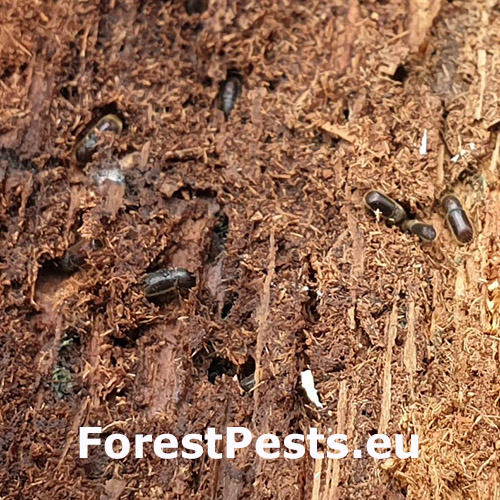
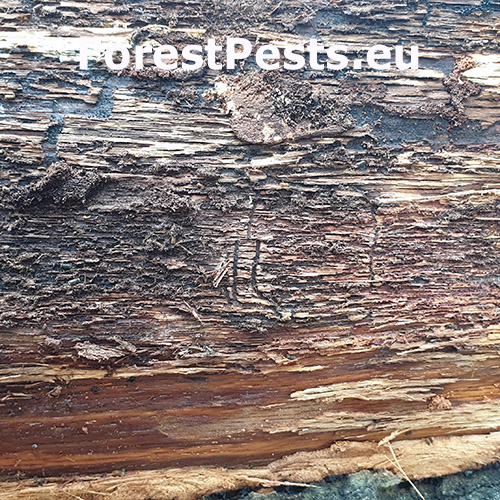
Bark beetle Taphrorychus villifrons is a species developing mainly in broadleaved trees. It breeds primarily in species of the families Fagaceae and Betulaceae, especially oaks (Quercus spp.), beeches (Fagus spp.) and hornbeams (Carpinus spp.), less frequently also on lime (Tilia spp.), Castanea spp. and other deciduous trees. The species is polygamous; several maternal galleries radiate from a central mating chamber and are located mainly in the phloem. Larval development takes place under the bark, where larvae feed and create characteristic gallery systems. The species usually colonises weakened, stressed or recently dead trees, but under favourable conditions it may also attack trees with reduced vitality. The intensity of attack is usually not strong, however repeated attacks can worsen the overall health condition of host trees and negatively affect their aesthetic appearance. In Europe, the species is recorded mainly in southern and central regions, with indications of gradual northward expansion, likely supported by climate warming.
Under the bark, star-shaped gallery systems with several maternal galleries radiating from a central chamber are present. Small round exit holes are visible on the bark surface, often accompanied by fine frass.
Tree Species: Birch, Beech, Oak, Hornbeam
Part of a plant- attacked: Tree trunk
Pest significance: Less harmful
Pest Category: Insects
Invasive Species: No
Present in EU: Yes
Pest group: Insect
Depth of damages: Under bark only
The extent of damage: Lokally
Prevalence in Europe: Common
Damaged products: Firewood, Fresh timber logs (water still in the sapwood)
Roundwood size: Diameter 50+, Diameter from 10 up to 50 cm, Diameter up to 10 cm
Wood discoloration: No
Exit holes: Round
Pest subcategory: Bark and underbark insect
Similar pests

Pityokteines vorontzovi

Phloeotribus spinulosus
