


Serpula lacrymans
Dry rot fungus
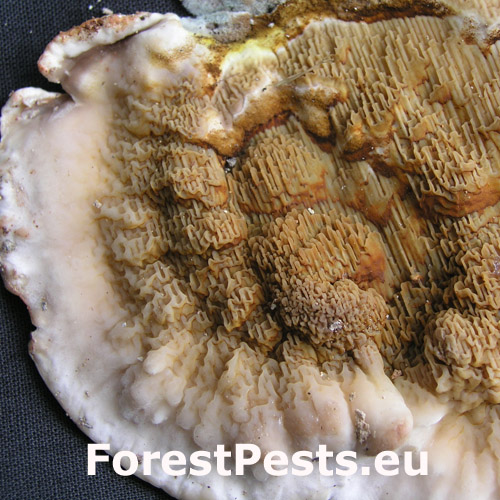
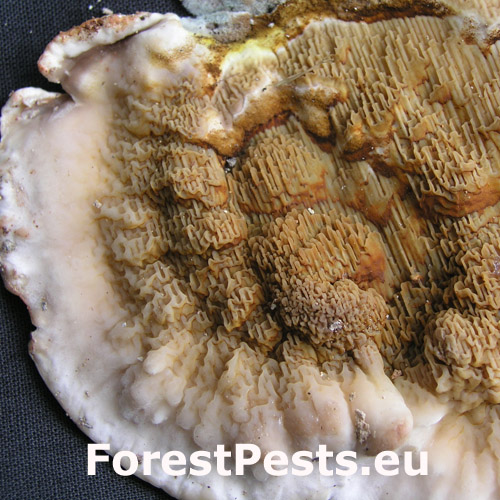
The fruiting bodies are annual, usually resupinate, 5-30 cm across, although they initially appear in shape of white cotton flakes. Later a yellowish orange to orange russet hymenium forms on the undulations in the centre. The cap retains a 2 cm wide white margin. The fruiting bodies develop in summer and autumn, but instead of outdoor habitats they inhabit dark cellars and lofts without access of light. Timber of dry constructions is also endangered, as the fungus doesn’t need much moisture. The fungus also creates white mycelial fans and string-shaped rhizomorphs. The decaying wood is brown and breaks in angular chunks. Water is generated by decay so copiously that mycelium is dewed with drops increasing the humidity of the site.
White cotton coatings.
Tree Species: Fir, Spruce, Larch
Part of a plant- attacked: Tree trunk, Branch
Pest significance: Less harmful
Pest Category: Fungi
Invasive Species: No
Present in EU: Yes
Pest group: Fungi
Affected part of wood: Heartwood
Depth of damages: More than 5 cm depth, Under bark only, Up to 0,5 cm depth, Up to 2 cm depth, Up to 5 cm depth
The extent of damage: Lokally
Prevalence in Europe: Common
Damaged products: Firewood, Furniture, Stored timber logs (dried wood)
Roundwood size: Diameter 50+, Diameter from 10 up to 50 cm
Wood discoloration: Yes
Pest subcategory: Brown-rot
Similar pests

Trypodendron domesticum

Coniophora puteana
