


Scolytus rugulosus
Shothole borer
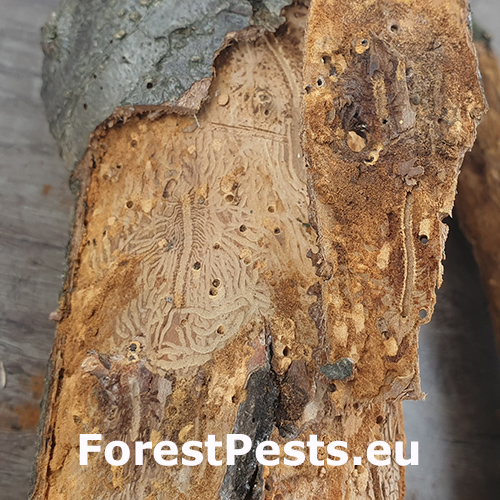
It is a polyphagous species with a body length of 1.4 to 3.2 mm. It mainly attacks weakened fruit trees. It is widespread throughout Europe and, depending on the conditions, has 1 to 2 generations per a year. After mating, the female bite a short longitudinal maternal corridor - 1 to 4 cm long. The larval corridors run perpendicular to the mother corridor, later twisting in different ways. The larvae overwinter and the subsequent pupae cradle in the wood. In some countries (like Turkey for example), this specie is considered an apricot pest.
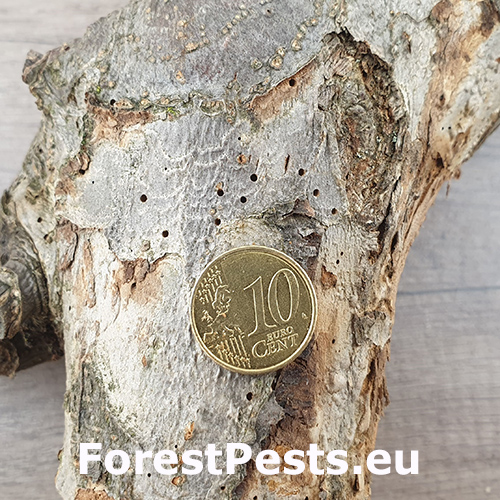
Exit holes with a diameter of approximately 1 to 1.5 mm. Under the bark are short longitudinal maternal corridors. The infested tree dries up in a few years. Often only the infested branch dries out. Woodpeckers are searching for overwintering larvae and thus markin the infested trees.
Tree Species: Cherry, Pear, Apple Tree, Apricots, Plum
Part of a plant- attacked: Tree trunk, Branch
Pest significance: Harmful
Pest Category: Insects
Invasive Species: No
Present in EU: Yes
Pest group: Insect
Affected part of wood: Bark, Underbark area
Depth of damages: Under bark only
The extent of damage: Lokally
Prevalence in Europe: Very common
Damaged products: Firewood, Fresh timber logs (water still in the sapwood), Stored timber logs (dried wood)
Roundwood size: Branches and twigs, Diameter 50+, Diameter from 10 up to 50 cm, Diameter up to 10 cm
Wood discoloration: No
Exit holes: Round
Pest subcategory: Bark and underbark insect
Similar pests

Ips duplicatus

Scolytus spp.
