


Saperda punctata
Long-horned beetle Saperda punctata
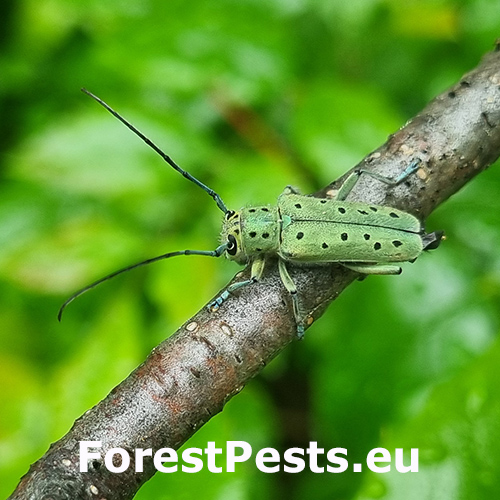
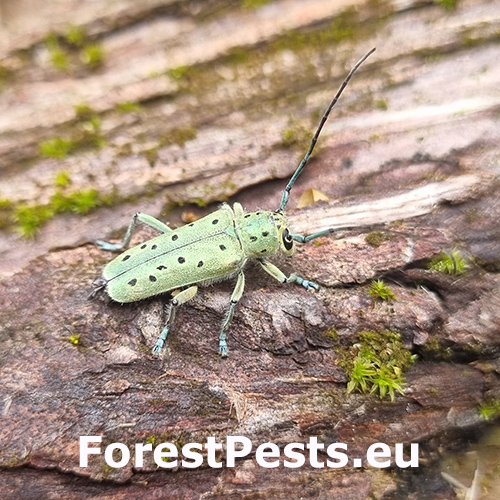
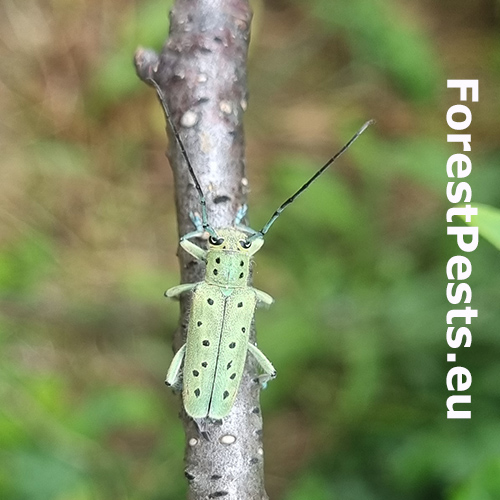
Saperda punctata is a polyphagous longhorn beetle whose larvae develop mainly in dead trunks and thick branches of deciduous trees. Rarely can be seen also on branches and stams of declining trees. It shows a strong preference for elms (Ulmus spp.), but has also been recorded from oaks (Quercus spp.) and willows (Salix spp.). The species is nocturnal and adults appear from May to August. The life cycle lasts one to two years, with larvae overwintering under the bark before pupating in sapwood. Though rarely abundant, its larval activity can reduce the vitality of ornamental trees in urban areas. In Europe, it is widespread but vulnerable in regions where mature elm trees have declined due to Dutch elm disease.
Oval exit holes and shallow larval galleries under bark of branches and trunks.
Tree Species: Elm, Oak, Willow
Part of a plant- attacked: Tree trunk, Branch
Pest significance: Less harmful
Pest Category: Insects
Invasive Species: No
Present in EU: Yes
Pest group: Insect
Affected part of wood: Sapwood
Depth of damages: Under bark only, Up to 0,5 cm depth
The extent of damage: Whole trunk
Prevalence in Europe: Rare
Damaged products: Firewood, Fresh timber logs (water still in the sapwood), Lumber, boards and prisms
Roundwood size: Branches and twigs, Diameter 50+, Diameter from 10 up to 50 cm, Diameter up to 10 cm
Wood discoloration: No
Exit holes: Oval
Pest subcategory: Bark and underbark insect

Similar pests

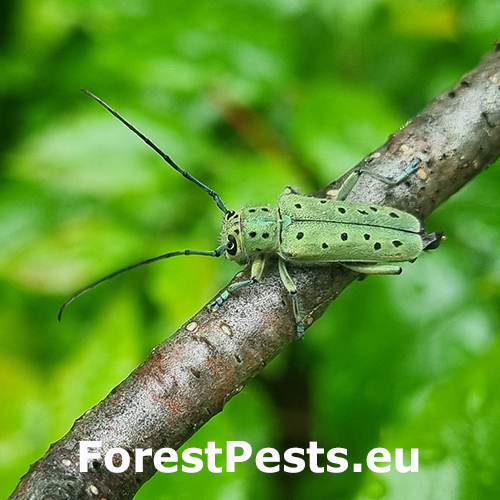
Monochamus sartor

Saperda perforata
