


Ganoderma carnosum
Ganoderma carnosum
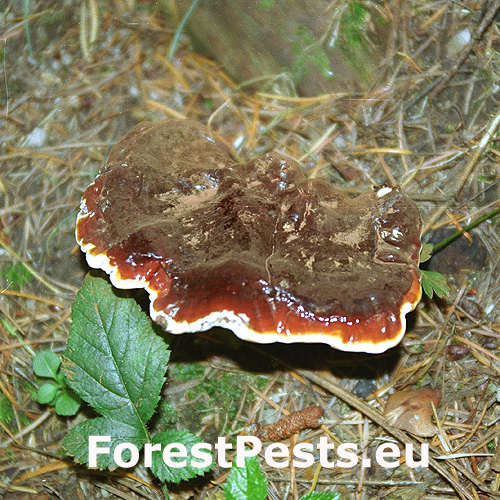
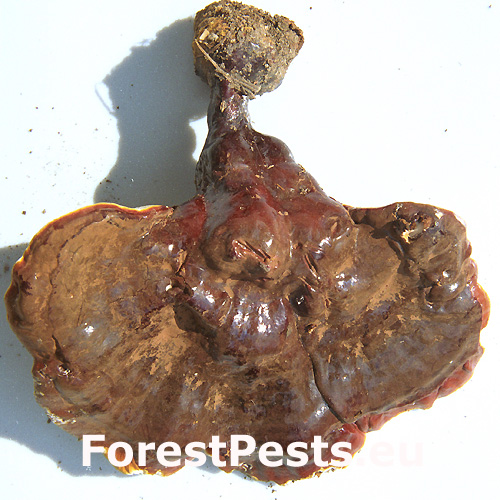
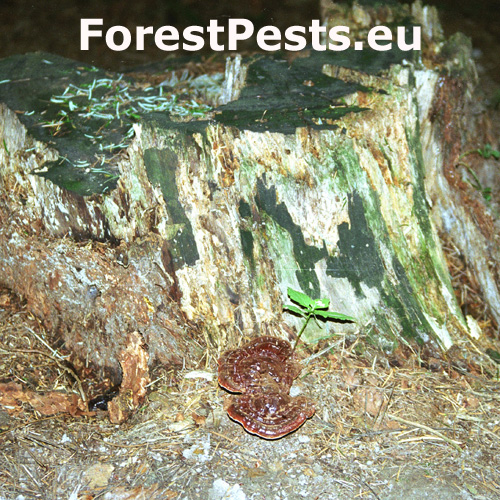
There are some species whose fruiting bodies are shiny, smooth, and with a hard surface. Ganoderma carnosum forms one-year fruiting bodies from May till October. Its cap is brownish red, up to 25 cm wide; its surface is shiny as if it was varnished, especially when young. The stem is usually formed and it is lateral, equally coloured (almost brownish black) and varnished as the cap. The fungus grows on died off roots and stumps, it causes white rot of conifers, especially of fir trees. It is spread in the Southern and Central Europe. Similar fruiting bodies are formed by Ganoderma lucidum, however, it usually grows on oaks and other broadleaves, and fruiting bodies are paler, especially when young. The preferable host species is Abies alba.
Its cap is brownish red, up to 25 cm wide; its surface is shiny as if it was varnished, especially when young.
Tree Species: Pine, Fir, Spruce, Larch
Part of a plant- attacked: Tree trunk
Pest significance: Less harmful
Pest Category: Fungi
Invasive Species: No
Present in EU: Yes
Pest group: Fungi
Affected part of wood: Heartwood, Sapwood
Depth of damages: More than 5 cm depth, Under bark only, Up to 0,5 cm depth, Up to 2 cm depth, Up to 5 cm depth
The extent of damage: Whole trunk
Prevalence in Europe: Common
Damaged products: Firewood, Fresh timber logs (water still in the sapwood), Furniture, Lumber, boards and prisms, Wooden house constructions
Roundwood size: Diameter 50+, Diameter from 10 up to 50 cm
Pest subcategory: White-rot
Similar pests

Trametes versicolor

Pleurotus ostreatus
