


Ganoderma applanatum (= lipsiense)
Ganoderma applanatum (= lipsiense)
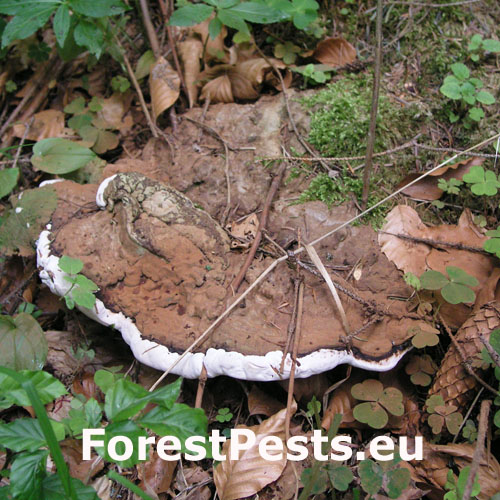
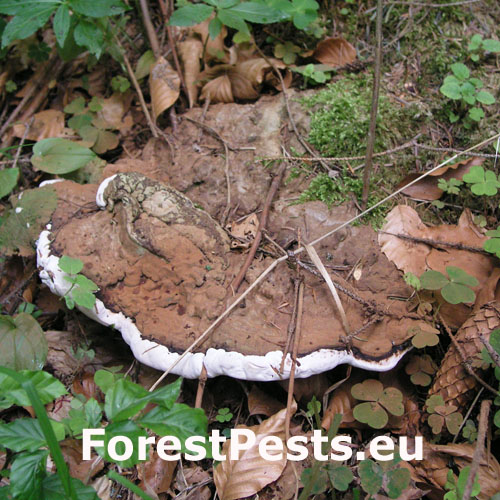
The fruiting bodies are permanent, concentrated on the surface, wavy, irregularly bumpy, smooth, light gray to brown when young, later dark and a thin brown bark is formed. Older fruiting bodies are usually covered with cinnamon brown dust from falling spores. The edge where the fruiting body grows every ear is white, at first blunt, later sharp. The pores on the underside are small, behind the young white, later rusty brown. The determinants of the flat crustacean also include the flies of the fly Agathomyia wankowiczi Schnabl, arises from the hymen of fruiting bodies that are conical 5-12 mm long and 3-8 mm wide. Fly leaves the hall through a hole in the middle of the hall. The result of the fungus is a white marbled rot of wood roots and root infestations of living and dead deciduous trees. Interestingly, the underside of the fruiting body is dark brown after injury, while there is no intense color range and thus sharp objects can be used to draw on the surface.
Fruiting bodies are covered with cinnamon brown dust from falling spores.
Tree Species: Elm, Beech, Cherry, Oak, Maple, Lime, Poplar
Part of a plant- attacked: Tree trunk, Roots
Pest significance: Harmful
Pest Category: Fungi
Invasive Species: No
Present in EU: Yes
Pest group: Fungi
Affected part of wood: Heartwood, Sapwood
Depth of damages: More than 5 cm depth, Under bark only, Up to 0,5 cm depth, Up to 2 cm depth, Up to 5 cm depth
The extent of damage: Whole trunk
Prevalence in Europe: Common
Damaged products: Firewood, Fresh timber logs (water still in the sapwood), Furniture, Lumber, boards and prisms, Wooden house constructions
Roundwood size: Diameter 50+, Diameter from 10 up to 50 cm
Pest subcategory: White-rot
Similar pests

Trametes hirsuta

Ganoderma australe
