


Ernobius mollis
Pine bark anobiid
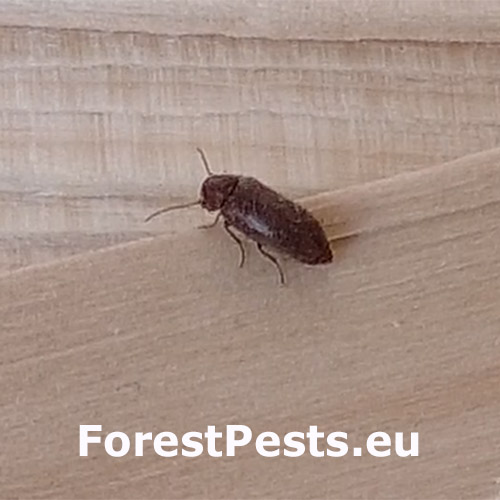

Pine bark anobiid Ernobius mollis is a beetle species associated exclusively with coniferous trees. It develops mainly in dead or recently felled wood with preserved bark, especially on pines (Pinus spp.), spruces (Picea spp.) and firs (Abies spp.). Females lay eggs into bark crevices, and larvae subsequently penetrate the growth layer beneath the bark. Larval development takes place partly in the inner bark and partly in the outer sapwood, where shallow feeding galleries are formed. The species has one generation per year. It usually colonises dead wood or construction timber containing bark edges and does not attack living trees. The intensity of attack is usually not strong and the damage is mostly superficial, therefore it does not significantly affect the mechanical properties of wood. However, the presence of numerous exit holes can negatively influence the aesthetic appearance of wooden elements. The species is widespread across Europe and is common wherever coniferous timber with bark remnants is present.
Shallow irregular galleries are present just beneath the bark and in the outer sapwood. Small round exit holes occur on barked wood surfaces, often visible along bark edges.
Tree Species: Pine, Fir, Spruce
Part of a plant- attacked: Tree trunk, Branch
Pest significance: Not harmful
Pest Category: Insects
Invasive Species: No
Present in EU: Yes
Pest group: Insect
Affected part of wood: Sapwood
Depth of damages: Bark, Under bark only
The extent of damage: Whole trunk
Prevalence in Europe: Common
Damaged products: Firewood, Fresh timber logs (water still in the sapwood), Furniture, Lumber, boards and prisms, Wooden house constructions
Roundwood size: Branches and twigs, Diameter 50+, Diameter from 10 up to 50 cm, Diameter up to 10 cm
Wood discoloration: No
Exit holes: Round
Pest subcategory: Bark and underbark insect
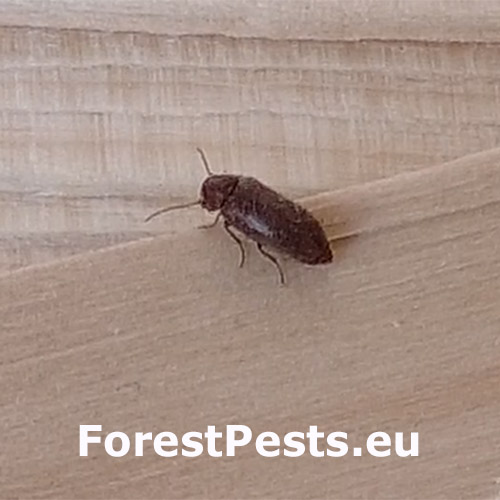
Similar pests

Ernobius mollis

Ips sexdentatus
