


Coniophora puteana
Cellar fungus
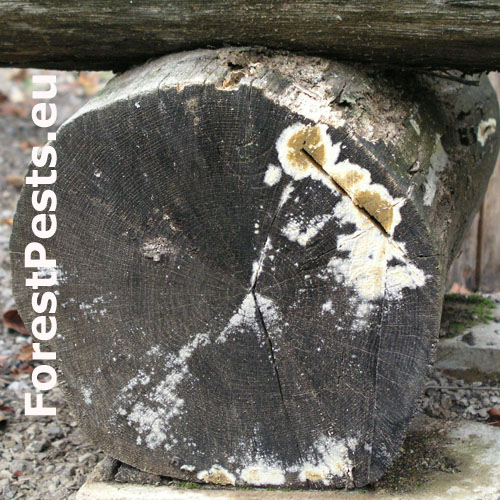
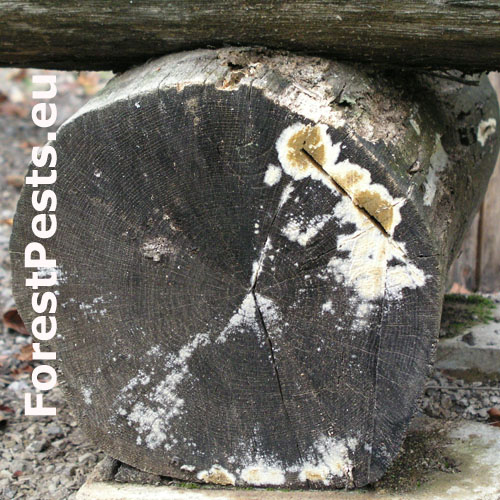
Annual fruiting bodies grow throughout the year, especially in summer and autumn. They are effused, pushed to the subsoil, 5-100 cm wide. The middle part is yellow, ocher to olive yellow due to maturing spores; the border is white, thinly webby. With age, crinkles and warts appear on the surface. Unlike most species of Corticiaceae family, the fruiting body can be carefully separated from the substrate because it is attached only partially. It occurs mostly on wet industrial wood in buildings, in the forest on dead stubs and branches. The mycelium causes wet dark brown rot.
Characteristic mycelium and mycelial cords are the most frequent diagnostic signs. The middle part is yellow, ocher to olive yellow due to maturing spores; the border is white, thinly webby.
Part of a plant- attacked: Tree trunk
Pest significance: Harmful
Pest Category: Fungi
Invasive Species: No
Present in EU: Yes
Pest group: Fungi
Affected part of wood: Sapwood
Depth of damages: More than 5 cm depth, Under bark only, Up to 0,5 cm depth, Up to 2 cm depth, Up to 5 cm depth
The extent of damage: Whole trunk
Prevalence in Europe: Very common
Damaged products: Firewood, Fresh timber logs (water still in the sapwood), Furniture, Lumber, boards and prisms, Wood chips, Wooden house constructions
Roundwood size: Diameter 50+, Diameter from 10 up to 50 cm
Wood discoloration: Yes
Pest subcategory: Brown-rot
Similar pests

False heardwood

Gloeophyllum sepiarium
