


Chlorophorus herbstii
Longhorn beetle Chlorophorus herbstii
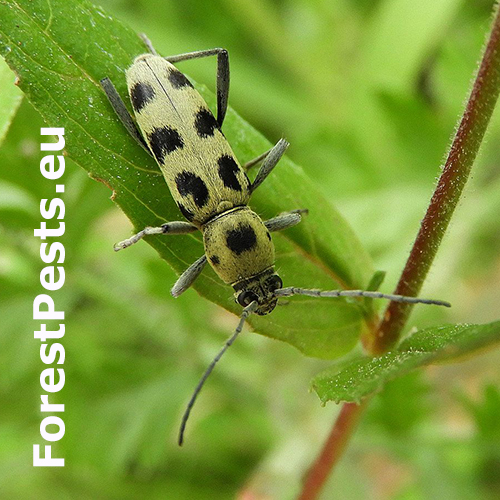
Chlorophorus herbstii is a longhorn beetle from the family Cerambycidae, commonly found in Europe, extending from Scandinavia to the Mediterranean. This species inhabits mixed deciduous forests, lime alleys, and parks. Larvae develop under the bark and in the wood of weakened or freshly dead branches and trunks of deciduous trees, preferring lime (Tilia), but also feeding on Carpinus, Quercus, and Fagus. The beetle’s lifecycle spans 2–3 years, with larvae overwintering and pupation occurring in spring. Adults are active in June and July, primarily on wood, occasionally on flowers.
The larval galleries damage the vascular system, leading to weakened tree vitality and reduced aesthetic valueThe infestation is accompanied by branch dieback, bark cracking, and presence of visible exit holes. Trees in urban parks or avenues are particularly susceptible, especially those under stress or aging.
Infested branches and trunks show irregular larval galleries alternating between wood and bark and going also several centimeters in the wood. Exit holes are visible, round, often surrounded by frass. Bark may crack, and wood surfaces appear roughened.
Tree Species: Elm, Oak, Hornbeam, Lime
Part of a plant- attacked: Tree trunk, Branch
Pest significance: Less harmful
Pest Category: Insects
Invasive Species: No
Present in EU: Yes
Pest group: Insect
Affected part of wood: Sapwood
Depth of damages: Bark, Up to 2 cm depth, Up to 5 cm depth
The extent of damage: Whole trunk
Prevalence in Europe: Rare
Damaged products: Firewood, Fresh timber logs (water still in the sapwood)
Roundwood size: Branches and twigs, Diameter 50+, Diameter from 10 up to 50 cm, Diameter up to 10 cm
Wood discoloration: No
Exit holes: Oval
Pest subcategory: Bark and underbark insect
Similar pests

Plagionotus detritus
