


Armillaria gallica
Bulbous honey fungus
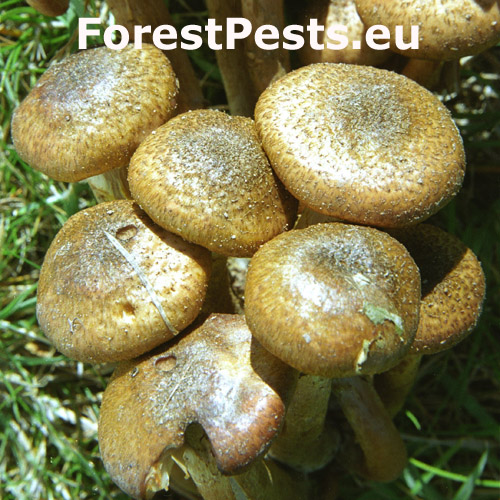
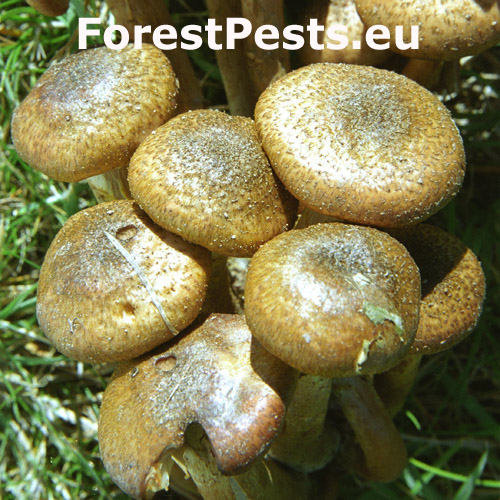
The hat is 2-6 cm wide, convex with a flat lid, sticky or dry, light brown to yellow-brown, usually with yellow capillaries on the surface. The depth is 5-10 cm long, with a yellowish color, thick under the hat, but on the base onion-thickened (due to sufficient space), which is not so pronounced in other rootstocks. The ring is cobwebby and short-lasting, white with a yellowish zone. Fruits form on the ground or near the roots of deciduous trees, they grow rather independently, or in loose clumps. The fungus is a saprophyte or a very weak parasite.
White coatings and brown twine-shaped formations under the bark, in autumn the presence of fruiting bodies on the roots, trunks and stems.
Tree Species: Beech, Oak, Lime, Poplar
Part of a plant- attacked: Tree trunk
Pest significance: Less harmful
Pest Category: Fungi
Invasive Species: No
Present in EU: Yes
Pest group: Fungi
Affected part of wood: Heartwood, Sapwood
Depth of damages: Under bark only, Up to 0,5 cm depth, Up to 2 cm depth, Up to 5 cm depth
The extent of damage: Whole trunk
Prevalence in Europe: Common
Damaged products: Firewood, Fresh timber logs (water still in the sapwood), Furniture, Lumber, boards and prisms, Wood chips, Wooden house constructions
Roundwood size: Diameter 50+, Diameter from 10 up to 50 cm
Wood discoloration: Yes
Pest subcategory: White-rot
Similar pests

Armillaria ostoyae

Auricularia auricula-judae
